Ultra-short-throw projectors need a different screen decision process from conventional projectors. The steep projection angle makes surface direction, flatness and ambient-light control unusually important.
Start with the room, not the marketing label
Ask where the unwanted light comes from, when you watch, how bright the projector is, where people sit and whether the screen can stay on the wall. Those answers narrow the screen type faster than a single specification.
The five specifications that matter most
| Factor | What to evaluate |
|---|---|
| UST compatibility | The optical structure must be designed for the projector's steep light angle. |
| Ambient-light behavior | Direction and intensity of ceiling, side and window light. |
| Gain | Balance between reflected brightness, uniformity and viewing cone. |
| Viewing angle | How far off-center your real seating extends. |
| Mounting style | Permanent fixed frame vs retractable floor-rising/drop-down. |
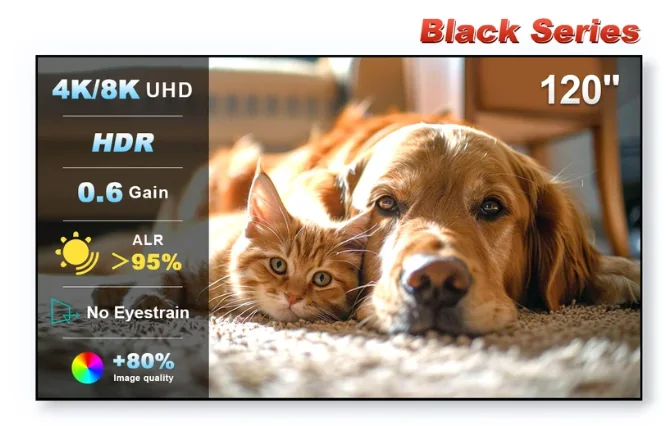
NothingProjector Black Series 120-inch ALR/CLR
Check current regional pricing, stock and merchant terms on the live offer page.
Check current price & availability →Why a white wall is not the same thing
A smooth wall can produce an image, especially in a dark room, but it does not provide the directional light control of a UST ALR surface. The difference becomes more visible as room light increases or as wall texture introduces small geometry and focus irregularities.
Where the Black Series fits
The NothingProjector Black Series sits in the fixed-frame, low-gain, UST-specific ALR/CLR category. The manufacturer lists 0.6 gain, 95% ambient-light rejection and a 170° viewing angle, making it aimed primarily at living rooms and media rooms rather than only light-controlled theaters.