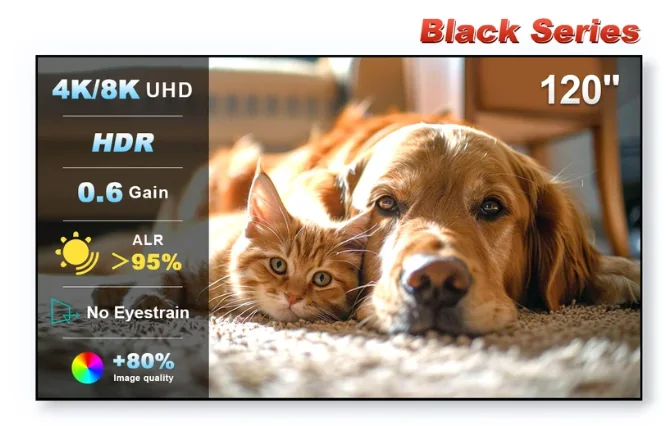
These answers focus on the questions that matter before buying and installing a large UST ALR screen.
Frequently asked questions
Is the Black Series 120-inch screen for UST projectors only?
Yes. The current merchant listing identifies it as compatible with ultra-short-throw projectors. A conventional long-throw ALR screen uses different optical geometry.
What does 0.6 gain mean?
It is a lower-gain surface, so peak reflected brightness is lower than a 1.0 reference surface. The design trades raw reflectivity for contrast control, wide viewing and ambient-light management.
Can I use a white wall instead?
You can test a UST projector on a smooth wall, especially in a dark room. A UST ALR surface adds directional ambient-light control and a flatter, purpose-built projection surface.
How wide is a 120-inch 16:9 picture?
Approximately 104.6 inches (2.66 m) wide by 58.8 inches (1.49 m) high before the frame.
Does ALR mean the room can be fully sunlit?
No screen makes direct sunlight irrelevant. ALR helps reject unwanted light, but shading direct sun and having enough projector brightness still matter.
Is a fixed-frame screen better than a floor-rising screen?
It is simpler and always ready, but it permanently occupies the wall. Floor-rising screens cost more and add mechanics, but can disappear when not in use.
Does this site claim hands-on testing?
No. Laser Screen Lab is a research-led publication. We distinguish manufacturer specifications from practical guidance and do not claim firsthand testing we have not performed.