Gain measures how strongly a screen reflects light in a particular direction compared with a reference surface. It is not a simple quality score: higher is not automatically better.
What 0.6 gain means
In basic terms, a 0.6-gain screen has lower peak reflectivity than a 1.0 reference surface. That sounds like a disadvantage until you factor in what the surface is trying to do: control the direction of reflected light and suppress unwanted ambient light.
Why lower gain can suit UST ALR
Many gray or dark UST ALR screens use lower gain to help deepen perceived blacks and reduce glare/hotspot behavior. In a mixed-light room, preserving contrast can matter more than maximizing the brightest white patch.
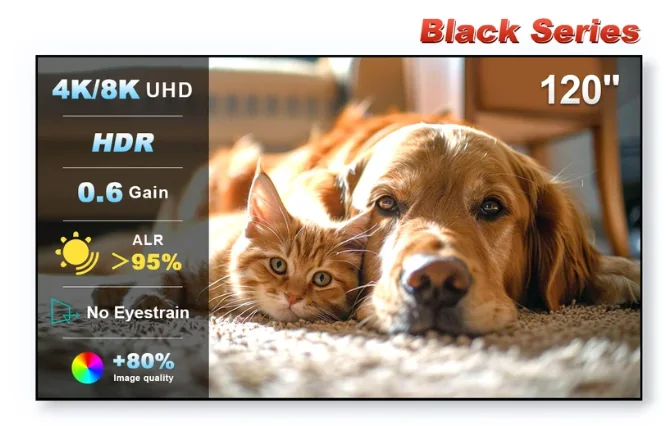
NothingProjector Black Series 120-inch ALR/CLR
Check current regional pricing, stock and merchant terms on the live offer page.
Check current price & availability →Gain, viewing angle and projector brightness interact
| Change | Typical effect |
|---|---|
| Higher gain | More peak brightness, often a narrower optimal viewing cone and more hotspot risk |
| Lower gain | Less peak brightness, often wider distribution and darker screen appearance |
| Brighter projector | More headroom to use a low-gain contrast-oriented screen |
| More room light | Raises the importance of ambient-light control |
Black Series context
The Black Series is listed at 0.6 gain with a 170° viewing angle. Those numbers make sense together: the product is positioned around wide seating and contrast control rather than a narrow high-gain brightness hotspot.