ALR and CLR are often treated like competing technologies, but in UST shopping they overlap. The more useful question is how the screen controls room light relative to the projector's very low projection angle.
ALR is the broader idea
ALR means ambient-light rejecting. It describes screens engineered to preserve image contrast by directing useful projector light toward viewers while reducing unwanted room light.
CLR is commonly used to mean ceiling-light rejecting and is often applied to UST-specific lenticular screens. In practical shopping, CLR can be treated as a UST-focused subset of ALR rather than a completely separate universe.
Why UST changes the optics
A conventional projector throws light from farther back in the room. A UST projector throws light upward from very close to the screen. A directional screen can exploit that difference: accept light from the projector's angle, then absorb or redirect much of the light arriving from above.
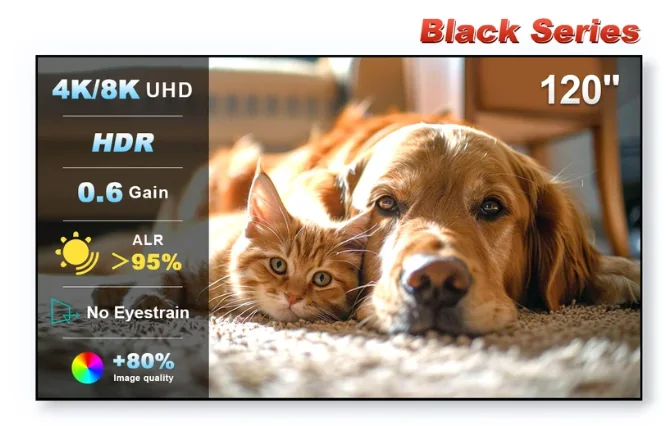
NothingProjector Black Series 120-inch ALR/CLR
Check current regional pricing, stock and merchant terms on the live offer page.
Check current price & availability →Don't choose by acronym alone
- Verify the screen is explicitly designed for UST.
- Check gain and viewing angle together.
- Think about where your room light actually originates.
- Check whether the screen is lenticular or Fresnel and how that affects seating.
- Prioritize a flat, correctly oriented installation.
How the Black Series is positioned
The merchant markets the Black Series using both ALR and CLR language. Its listed 0.6 gain and 170° viewing angle place it in the wide-viewing lenticular style commonly chosen for living-room UST systems.